
As an efficient, safe, and environmentally friendly vertical conveying equipment, the bucket elevator is widely used for the vertical transport of powdered materials, fine materials, and coarse particles. It plays an important role in grinding production lines. This article shares the common faults of bucket elevators and their solutions.
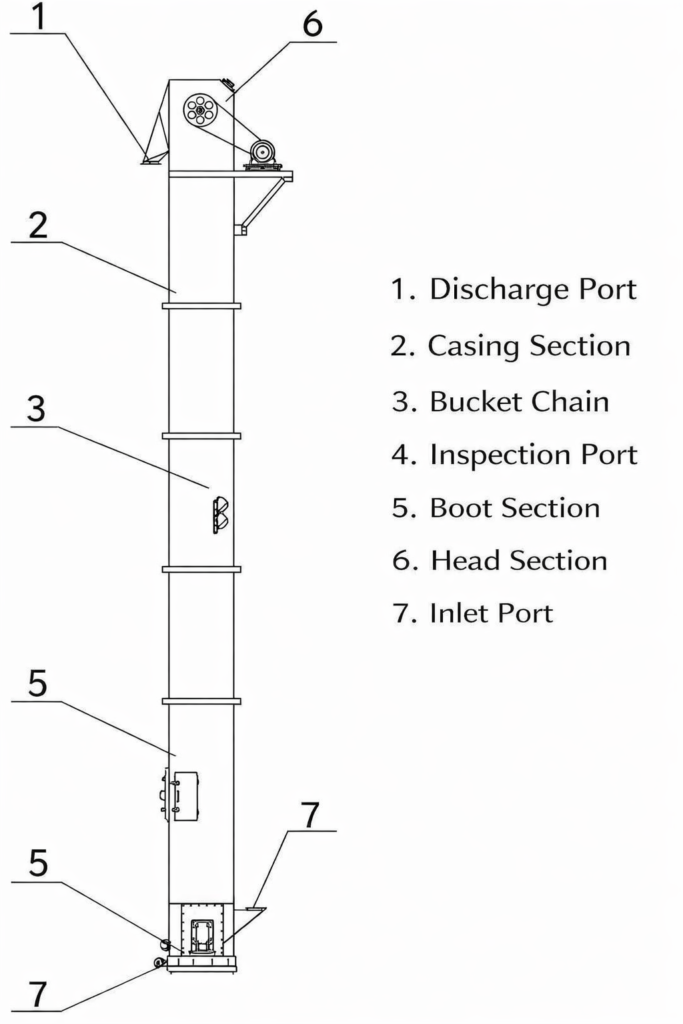
01 Severe Material Backflow at the Head
There are many reasons for severe material backflow at the head of a bucket elevator, mainly including the following:
① The bucket structure design is unreasonable, and the material cannot be discharged completely.
② The head rotation speed is too low.
③ The discharge height at the head is insufficient.
④ The gap between the discharge lip plate and the bucket edge is too large.
Solutions: Optimize the bucket structure design to ensure proper material throwing; appropriately increase the rotation speed of the bucket elevator to ensure smooth discharge; adjust the head height so that the material trajectory matches the discharge outlet; reduce the gap between the discharge lip plate and the bucket edge to allow material to pass smoothly into the outlet.
02 Drive Motor Failure
The main cause of drive motor failure is excessive temperature, which can lead to motor burnout. The reasons for high motor temperature include insufficient motor design power, or certain components of the bucket elevator being jammed, causing a “stall” condition.
When components of the bucket elevator are jammed and cause a “stall,” special attention must be paid during installation and commissioning. Once a stall occurs, the power supply should be cut off immediately, the cause should be identified, and adjustments should be made promptly. The equipment should only be restarted after the fault is cleared.
At the same time, for bucket elevators with drive power above 30 kW, it is recommended to use a hydraulic coupling, as it provides overload protection and can prevent the motor from being damaged by sudden overload, ensuring normal operation of the bucket elevator.
03 Head Shaft Fracture
The head of the bucket elevator is an important component of the whole machine. The head drum bears the traction chain or belt, as well as the full weight of the buckets and the conveyed materials. Therefore, the shaft of the head drum is very prone to fracture. The reasons for head shaft fracture are as follows:
① The strength of the head shaft is insufficient, mainly due to lack of heat treatment or heat treatment not meeting requirements.
② The material of the head shaft does not meet standards.
③ The structural design of the head shaft is unreasonable, and stress concentration may occur at transition steps.
④ Long-term overload operation leads to fatigue fracture of the head shaft.
For the stress condition of the head shaft, it is necessary first to analyze whether the bucket elevator has been operating under long-term overload, causing fatigue fracture. If so, measures should be taken to strictly avoid overload. Secondly, check whether the material selection and structural design are reasonable. The head shaft is generally made of 45# steel or 40Cr. If the material selection is not appropriate, better materials should be used.
In structural design, fillets should be applied at the shaft transition steps to avoid stress concentration, otherwise it may easily cause shaft fracture. The strength of the head shaft mainly depends on the heat treatment results. Generally, the hardness after heat treatment should be within HB220–260.
04 Hydraulic Coupling Failure
The hydraulic coupling is one of the essential components of a bucket elevator. It is installed between the motor and the reducer. It is a soft-start coupling that transmits torque through hydraulic power, effectively transmitting torque while also protecting the motor and reducer.
During normal operation, common failures of the hydraulic coupling include: insufficient or excessive oil filling, oil leakage, deterioration of hydraulic oil, and overheating of the oil due to overload of the bucket elevator. This overheating may melt the fusible plug, causing oil leakage and disconnecting the motor from the reducer.
To address these common faults, effective measures can fully control hydraulic coupling failures. First, the oil filling volume must meet requirements, and any oil leakage should be handled promptly. At the same time, the hydraulic oil should be checked regularly, and replaced immediately if it deteriorates.
During normal operation of the bucket elevator, overload must be controlled. When the equipment is overloaded, resistance increases, resulting in higher load. The motor torque may become insufficient to drive the load, causing the driving wheel of the hydraulic coupling to rotate at high speed while the driven wheel remains stationary or rotates at low speed. This leads to excessive oil temperature, melting of the fusible plug, oil leakage, and disconnection of the coupling. Therefore, overload must be avoided as much as possible.
05 Reducer Damage
Bucket elevators generally operate with relatively high power, and reducer failure is also one of the common faults. Common reducer failures include high-speed shaft fracture, gear tooth damage, bearing failure, and insufficient lubrication.
To solve reducer damage, the most common method is to install a hydraulic coupling between the motor and the reducer. By using the soft-start function of the hydraulic coupling, failures such as high-speed shaft fracture and gear damage caused by rigid coupling connections can be avoided.
At the same time, the oil level and oil quality inside the reducer should be checked regularly. If oil is insufficient, it should be replenished in time, and if oil quality deteriorates, it should be replaced promptly. These measures can significantly reduce the probability of reducer failure.
06 Bearing Damage of Head Drive Drum
The head of the bucket elevator is driven by the motor through the reducer, which ultimately drives the head drum. Therefore, the bearings of the head drive drum are subjected to large radial forces, resulting in a higher probability of damage.
The common causes of bearing damage are as follows:
① Improper selection during design, resulting in insufficient load capacity, leading to damage under momentary overload.
② Poor lubrication maintenance or deterioration of lubricating oil, causing insufficient lubrication and “dry friction,” which accelerates bearing damage.
③ Bearing quality issues, such as counterfeit or refurbished bearings, which can lead to failure.
To solve this problem, the following measures can be taken: during equipment design, fully consider the overload factor of the bucket elevator. After calculating the bearing model, select a bearing one or two sizes larger to meet operational requirements.
At the same time, perform regular maintenance according to the maintenance plan, replace old oil with new oil to ensure proper lubrication, and select high-quality branded bearings to avoid counterfeit products. These measures can effectively reduce bearing failure.
07 Bucket Detachment
The bucket is the load-bearing component of the bucket elevator and is a critical part. Buckets are connected to the traction belt or chain through bolts. If the bolt strength is insufficient, bolts become loose, or the bolts and nuts are not properly secured after tightening, loosening may occur over time, leading to fatigue failure and shearing.
In addition, if collision or jamming occurs during operation, it may also cause bucket detachment.
To prevent bucket detachment, the first step is to ensure proper bolt selection. High-strength bolts should be used, and regular inspection is necessary to prevent loosening. It is important to weld the bolts securely after tightening to prevent loosening due to weld failure.
At the same time, frequent inspection of bucket operation is required. If jamming or collision is found, it should be addressed promptly. Timely inspection and early detection are key to preventing bucket detachment.
08 Severe Bucket Wear
During operation, the bucket is responsible for scooping, conveying, and discharging materials, so its wear resistance is extremely important. Since the bucket is in close contact with materials, the bucket lip is prone to wear.
In some cases, large material particle size can cause increased wear during scooping. In addition, the bucket elevator usually operates at high speed, and excessive speed can further increase wear between the bucket and materials.
To address bucket wear, if the material is highly abrasive, more wear-resistant materials should be used to manufacture the buckets. For example, nylon buckets are commonly used in the grain industry, which can improve wear resistance while reducing weight.
If the material particle size is large and cannot be changed, a larger bucket elevator model should be selected, or a belt conveyor with an incline can be used instead.
At the same time, the operating speed of the bucket elevator should be adjusted appropriately to ensure smooth material scooping and discharge.
09 Severe Material Accumulation at the Tail
Material accumulation at the tail is a common fault in bucket elevators. The main causes include:
① Uneven feeding, with excessive instantaneous material input causing blockage at the tail, commonly known as “stalling.”
② The designed conveying capacity does not meet actual requirements, leading to long-term accumulation.
③ Improper design of operating speed or discharge structure, resulting in incomplete discharge and material returning to the tail.
To solve this issue, the feeding rate of upstream conveying equipment should be strictly controlled to ensure uniform feeding and prevent sudden overload.
If the bucket elevator capacity is insufficient, a larger model should be selected.
In addition, the operating speed should be designed according to the material characteristics, and the discharge outlet should be properly designed in position and shape to ensure complete discharge and prevent material from returning to the tail. These measures can effectively control tail accumulation.
10 Excessive Vibration and Noise
For bucket elevators operating for more than five years, vibration and noise often increase to varying degrees. The main causes include:
① Insufficient installation accuracy, resulting in poor vertical alignment, causing misalignment between head and tail pulleys and leading to vibration.
② Bucket detachment or collision with the casing during operation.
③ Partial loss of bolts connecting the bucket and belt, causing bucket misalignment and generating lateral force, resulting in uneven load and vibration, accompanied by noise.
④ Excessive looseness or deformation of the chain or belt, causing lateral swinging during operation.
To address vibration and noise, the following measures can be taken: during installation, use advanced equipment for real-time monitoring to ensure installation accuracy meets requirements, ensuring proper alignment and verticality.
Regularly inspect bucket operation, promptly repair or replace detached buckets to avoid lateral forces.
If the chain is too loose, shorten or replace it to ensure proper tension.
If the belt has undergone plastic elongation due to stress, it can be shortened by rejoining the belt.
After these adjustments, the bucket elevator can operate smoothly with reduced vibration and noise.